Blog / New laws
How Much Can a Landlord Raise Rent in California in 2026?
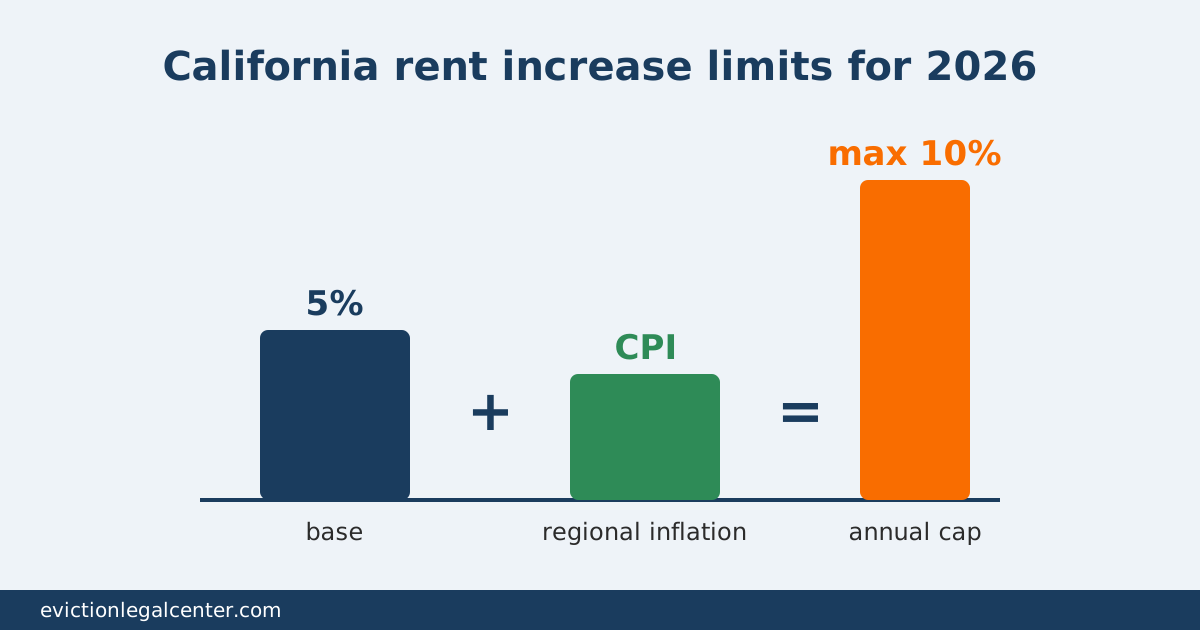
- Under AB 1482, most California rentals may go up by no more than 5% plus regional inflation, capped at 10% in any 12 months.
- From August 1, 2026, the cap in Los Angeles and Orange Counties is 8.7% (5% plus the 3.7% Los Angeles area CPI).
- Give 30 days written notice for increases of 10% or less, and 90 days for more than 10% where the law allows it.
- Local rent control (for example Los Angeles, Santa Monica, Pasadena, Santa Ana) can set a lower limit. Always check the city first.
Raising the rent is one of the most common questions we get from landlords, and one of the easiest places to make an expensive mistake. Here is how rent increases work in California in 2026, with a focus on Orange County and Los Angeles County.
1. Does AB 1482 cover your property?
The Tenant Protection Act of 2019 (AB 1482, Civil Code 1947.12) limits rent increases for most residential units in California. Common exemptions include:
- Units built within the last 15 years (a rolling date).
- Single family homes and condominiums owned by individuals, but only if the lease contains the exact exemption notice required by the statute. Without that notice, the home is covered.
- A duplex where the owner lives in one of the units.
- Units already covered by a stricter local rent control law, which then controls instead.
- Certain deed restricted affordable housing and dormitories.
2. How the cap is calculated
The maximum increase over any 12 month period is 5% plus the percentage change in the regional Consumer Price Index, but never more than 10%. The figure updates every August 1 using the April CPI. For the Los Angeles, Long Beach and Anaheim area, April 2026 inflation was 3.7%, so the cap from August 1, 2026 is 8.7% (up from 8.0% the year before).
Example: rent of $2,800 can rise by up to $243.60, to $3,043.60. The increase is measured against the lowest rent charged in the prior 12 months, and you may raise the rent no more than twice in those 12 months as long as the total stays under the cap.
3. Check local rent control first
Many cities have their own rent stabilization laws with lower limits and their own rules on registration and fees. In the City of Los Angeles, older units under the Rent Stabilization Ordinance follow the city's annual percentage, not the state cap. Unincorporated Los Angeles County, Santa Monica, West Hollywood, Pasadena and Santa Ana also have local rules. Our city pages list the local requirements for each area we serve.
4. Give proper written notice
Under Civil Code 827, a month to month tenant must receive at least 30 days written notice of an increase of 10% or less. If the total increase over 12 months is more than 10% (possible only for exempt units), the notice period is 90 days. If you serve the notice by mail, add five days. For fixed term leases, you generally cannot raise the rent until the term ends unless the lease allows it.
5. What happens if you overcharge
An increase above the cap is not enforceable, and the tenant can recover the overcharge. Since SB 567 took effect in 2024, a landlord who violates AB 1482 can also face actual damages, attorney fees and, for willful violations, penalties of up to three times the actual damages. Rent collected under an invalid increase also cannot be included in a 3 day notice, so an overcharge can sink a later eviction case.
Common mistakes
- Assuming a single family home is exempt without the required notice in the lease.
- Using last year's percentage after August 1.
- Ignoring a city's rent control law that sets a lower limit.
- Giving only 30 days notice for an increase over 10%.
- Raising rent in retaliation after a tenant complains about repairs, which is illegal under Civil Code 1942.5.
This article is general information about California law, not legal advice for your situation. Figures change every August 1, and local rules can differ.
Related: New California rental laws for 2026 | Request a case review
This article is general information about California law as of its date, not legal advice for your situation. Laws and local ordinances change, and court decisions can be reviewed or reversed. Reading it does not create an attorney client relationship.