Blog / Local rules
Los Angeles Relocation Assistance Amounts for 2026
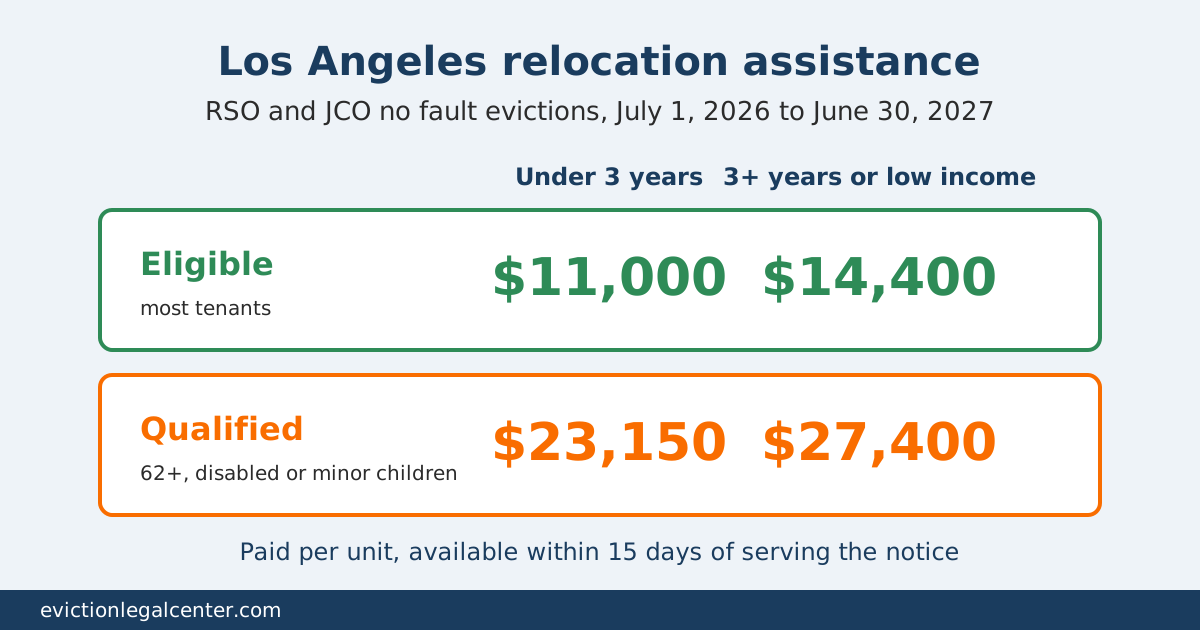
- LAHD's current relocation bulletin covers July 1, 2026 through June 30, 2027. Amounts increase every July 1.
- For a no fault eviction from an RSO or JCO unit, the base amounts run from $11,000 to $27,400 per unit, depending on whether the tenant is "qualified," how long they have lived there, and their income.
- Payment must be made available within 15 days of serving the notice of termination, directly or through an escrow account.
- Unincorporated Los Angeles County has its own relocation rules under the County ordinance, enforced by DCBA.
When relocation is owed
In the City of Los Angeles, relocation assistance is owed when a tenant in a unit covered by the Rent Stabilization Ordinance (RSO) or the Just Cause Ordinance (JCO) is displaced for a no fault reason. Common examples are an owner or family member move in, a resident manager move in, withdrawing the building from the rental market under the Ellis Act, demolition, and compliance with a government order to vacate.
No relocation is owed for at fault terminations, such as nonpayment of rent, an uncured lease violation or nuisance. The landlord pays, and the payment is per unit, not per tenant.
Current amounts: July 1, 2026 to June 30, 2027
These figures are from LAHD's Relocation Assistance Bulletin (Chart A) for RSO and JCO units.
| Tenant household | Less than 3 years | 3 years or more, or low income | "Mom and Pop" owner move in |
|---|---|---|---|
| Eligible | $11,000 | $14,400 | $10,550 |
| Qualified | $23,150 | $27,400 | $21,250 |
JCO single family home exception. Under the JCO, when the rental is a single family home owned by a natural person (not an LLC or corporation) who meets the ordinance's limit on other units owned, relocation is one month's rent that was in effect when the notice was served. LAHD notes that a condominium does not qualify for this lower amount.
Demolition for new construction. When a protected unit, which includes every RSO unit, is demolished for new construction, the Resident Protections Ordinance sets higher standardized payments for lower income households. For the same period LAHD lists $115,480 for extremely low income, $96,750 for very low income and $87,450 for low income households. Households above low income receive the Chart A amounts. Where more than one amount applies, the owner must pay the highest.
Qualified, eligible and low income tenants
- Qualified tenant: on the date the notice of termination is served, the tenant is 62 or older, is disabled or handicapped as defined in the statutes LAHD cites, or has one or more minor dependent children. If anyone in the household is a qualified tenant, use the qualified row.
- Eligible tenant: any tenant who is not a qualified tenant.
- Low income: household income at or below 80 percent of Area Median Income for the household size. Low income tenants receive the higher "3 years or more" column regardless of how long they have lived there.
Ask for the information you need in writing and keep the responses. A tenant's age, disability or children can change the amount by more than $12,000, and a dispute is far cheaper to resolve before the notice than in court.
The "Mom and Pop" reduced amount
The reduced amounts apply only to evictions for occupancy by the owner or an eligible relative, and only if all of these are true:
- The building has four or fewer rental units.
- The landlord has not used this provision in the previous three years.
- The landlord owns no more than four residential units plus a single family home on a separate lot in Los Angeles.
- The relative moving in does not own residential property in Los Angeles.
When and how to pay
- The payment must be made available within 15 days of serving the written notice of termination.
- You may use an escrow account at your own cost, but the funds must be deposited within the same 15 days. Escrow must release payments within three working days of a tenant's request.
- If one tenant lives in the unit, that tenant receives the full amount. With several tenants, each receives an equal share.
- No fault cases also require a Landlord Declaration of Intent to Evict with LAHD, with fees, and the notice itself must be filed with LAHD within three business days of service.
State law under the Tenant Protection Act (Civil Code 1946.2) requires one month's rent for many no fault terminations, but where a local ordinance gives more protection, the local rule controls. In the City of Los Angeles that means the LAHD amounts.
Unincorporated Los Angeles County
Properties in unincorporated areas, such as East Los Angeles, Altadena or Marina del Rey, follow the County's Rent Stabilization and Tenant Protections Ordinance instead. According to DCBA, County permanent relocation for no fault evictions is based on the number of bedrooms rented, not the number of occupants, and a higher amount applies if the household includes a qualified tenant (62 or older, disabled, terminally ill, or with children under 18) or a lower income tenant. Payment, or access to an escrow account, is due when the no fault notice is served. DCBA updates the County amounts periodically, so get the current schedule from the DCBA Rent Stabilization Program before serving notice. See also our article on the County's two month nonpayment threshold.
Common mistakes
- Using last year's chart after July 1.
- Paying the eligible amount when a household member is 62 or older, disabled or a minor child.
- Treating an LLC owned single family home as eligible for the one month JCO exception.
- Missing the 15 day deadline, or opening escrow late.
- Applying City amounts to a property that is actually in another city or in unincorporated County territory.
- Offering a buyout instead of relocation without following the City's buyout rules. See cash for keys.
Get the numbers right before you serve
A no fault eviction in Los Angeles is a paperwork heavy process, and a relocation error can defeat the case. Our online notices are $150 each, and we can prepare the 30, 60 or 90 day notice once the relocation amount is settled. Request a free case review and we will look at the tenancy, the ownership and the correct amount. For an overview of all the City rules, see our Los Angeles landlord compliance guide.
This article is general information about Los Angeles and California law, not legal advice for your situation. Relocation amounts change every July 1; confirm the current LAHD or DCBA bulletin before serving a notice.
Related: Owner move in evictions after SB 567 | Request a case review
This article is general information about California law as of its date, not legal advice for your situation. Laws and local ordinances change, and court decisions can be reviewed or reversed. Reading it does not create an attorney client relationship.