Blog / Local rules
The Ellis Act in Los Angeles: Taking Units Off the Market
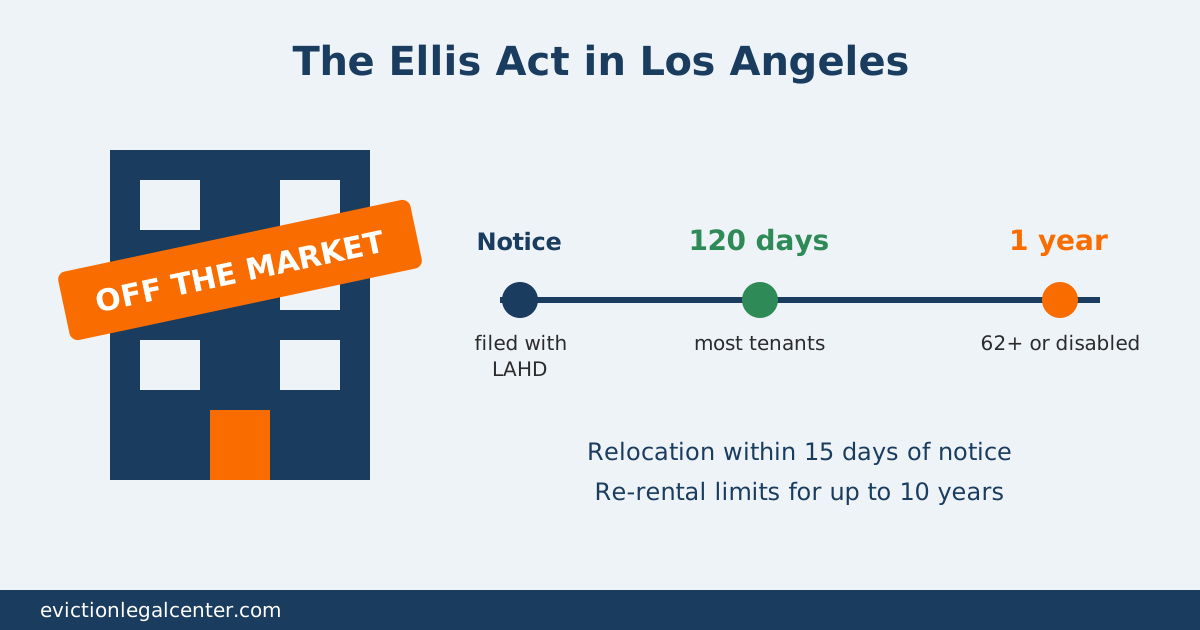
- The state Ellis Act (Government Code 7060 to 7060.7) lets an owner go out of the residential rental business, even in a rent controlled building.
- In the City of Los Angeles, the process runs through LAHD under LAMC 151.22 to 151.28: record a memorandum, file a Notice of Intent to Withdraw, notify tenants, and pay relocation.
- Withdrawal is effective 120 days after the notice is delivered to the City, or one year for a tenant who is 62 or older or disabled, has lived in the unit at least a year, and claims the extension within 60 days.
- Re-renting is restricted for years afterward, and the property keeps its RSO status.
What the Ellis Act allows
California adopted the Ellis Act in 1985 after the Nash v. City of Santa Monica decision, in which a city had required an owner to keep renting. The Act says a city or county may not compel an owner to continue offering residential units for rent. In Los Angeles, the Rent Stabilization Ordinance lists withdrawal of units from the rental market as a no fault reason to end an RSO tenancy (LAMC 151.09 A.10), and LAHD administers the procedure.
The Ellis Act is not a tool to remove one difficult tenant. It is designed for owners who are leaving the rental business for the property, and an owner generally must withdraw all of the rental units in the building, not just some.
The LAHD procedure
LAHD's owner materials describe a series of numbered forms. In order:
- Record a memorandum with the Los Angeles County Recorder's Office describing the withdrawal, with an accurate legal description of the property. The restrictions it describes bind later owners.
- File the Notice of Intent to Withdraw Units from Rental Housing Use with LAHD, with a copy of the recorded memorandum and the administrative fees.
- Notify each occupied unit within 5 days of filing the Notice of Intent, using LAHD's Notice to Tenant of Pending Withdrawal together with a blank Notice of Interest in Renewing Tenancy, which the tenant can return to ask for a future offer.
- Serve the 120 day notice terminating the tenancy, and file that notice with LAHD within three business days of service.
- Pay relocation within 15 days after service of the notice, directly or into escrow.
- File follow up forms as needed, such as the notice of extended withdrawal dates, a notice of intention to re-rent, and an annual property status report, which LAHD requires for seven years or until it confirms reporting is complete.
Forms and fees change, so get the current packet from LAHD before starting.
Notice periods: 120 days or one year
Under Government Code 7060.4, the withdrawal date is 120 days after the owner's notice is delivered to the City. A tenant who is at least 62 or disabled and has lived in the unit for at least one year before that notice can extend their own tenancy to one year, but only by giving the owner written notice of the claim within 60 days after the owner's notice was delivered to the City.
If the units will be demolished for new construction, LAHD notes that the state Housing Crisis Act calls for a six month notice to terminate, along with the City's Resident Protections Ordinance.
Relocation assistance
Ellis tenants are entitled to the City's no fault relocation assistance. For July 1, 2026 through June 30, 2027 the RSO amounts range from $11,000 to $27,400 per unit, and higher standardized payments apply to lower income households when units are demolished for new construction. See Los Angeles relocation assistance amounts for 2026 for the full chart. LAHD warns that relocation violations under the Resident Protections Ordinance can bring penalties of around $250,000 per unit and holds on demolition permits.
Re-rental restrictions
Withdrawal does not free the units from regulation forever. The main limits are:
- Within 2 years: if the units are offered for rent again, the owner must first offer them to displaced tenants who asked in writing within 30 days of displacement. The offer goes by registered or certified mail. The owner is also liable to the displaced tenant for actual and exemplary damages, and the City may sue for exemplary damages (Gov. Code 7060.2(b)).
- Within 5 years: units rented again must be offered at the lawful rent in effect when the Notice of Intent was filed, plus the annual RSO adjustments since then (Gov. Code 7060.2(a)).
- Within 10 years: displaced tenants keep a right of first refusal if the units return to the rental market. A failure to offer can bring punitive damages (Gov. Code 7060.2(c)).
- RSO status stays. LAHD states that the Ellis Act does not remove a property's RSO status. ZIMAS shows an "Ellis Act Property" field under Housing, although recent filings may not appear yet.
- New construction: new units built on the site and offered for rent within five years may be subject to rent controls (Gov. Code 7060.2(d)), and City replacement unit rules can apply.
Ellis and the unlawful detainer
If a tenant has not moved by the withdrawal date, the owner files an unlawful detainer like any other no fault case. Government Code 7060.6 lets the tenant defend by showing the owner did not comply with the Ellis rules. The court can look at every step, from the recorded memorandum to the relocation payment. A gap in the paper trail is the most common reason an Ellis eviction fails.
Common mistakes
- Trying to withdraw only some units, or using the Ellis Act to target one tenant.
- Missing the 5 day tenant notification after filing the Notice of Intent.
- Filing the unlawful detainer before a senior or disabled tenant's one year extension has run.
- Paying relocation late or using an outdated chart.
- Re-renting without checking the 2, 5 and 10 year rules.
- Stopping RSO registration while units are still occupied. LAHD bills occupied units even for part of a year.
Thinking about leaving the rental market?
An Ellis withdrawal is a long, document driven process, and a negotiated move out is sometimes faster. Compare the options in our cash for keys guide, then request a free case review. If a tenant later stays past the withdrawal date, we handle the unlawful detainer. For routine matters, our online notices are $150 each. See also our Los Angeles landlord compliance guide.
This article is general information about Los Angeles and California law, not legal advice for your situation. Ellis Act procedures, forms and fees change; confirm the current LAHD requirements before filing.
Related: RSO vs. JCO in Los Angeles | Request a case review
This article is general information about California law as of its date, not legal advice for your situation. Laws and local ordinances change, and court decisions can be reviewed or reversed. Reading it does not create an attorney client relationship.