Blog / Local rules
RSO vs. JCO: Which Los Angeles Rule Covers Your Building?
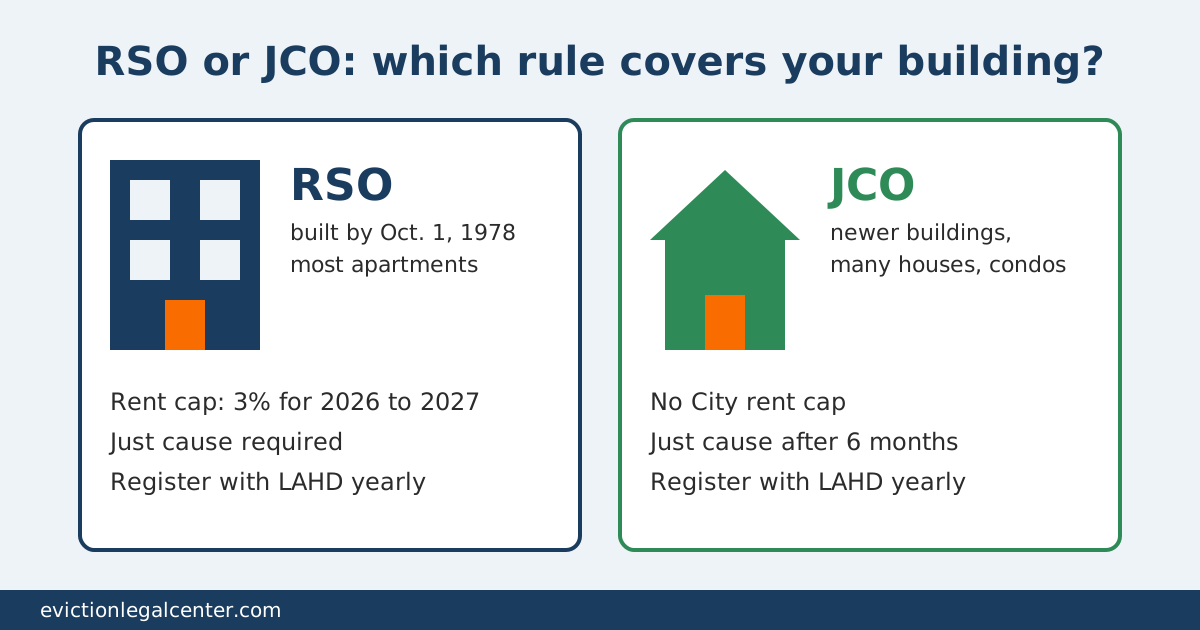
- The RSO (Rent Stabilization Ordinance) covers most rental units in the City of Los Angeles first built on or before October 1, 1978. It limits rent increases and requires just cause to evict.
- The JCO (Just Cause Ordinance) covers most other rental units in the City, including newer buildings and many single family homes and condos. It requires just cause but does not set a City rent cap.
- The RSO allowable increase for July 1, 2026 through June 30, 2027 is 3%, with no extra percentage for utilities.
- For either ordinance, a nonpayment eviction requires that the tenant owe more than one month of fair market rent for the unit size.
Two ordinances, one city
Owners in the City of Los Angeles often ask whether their building is "rent controlled." The better question is which of the City's two ordinances applies, because nearly every residential rental in the City falls under one of them. Getting this wrong can cost you an eviction case.
These rules apply only inside City limits. Santa Monica, West Hollywood, Beverly Hills, Pasadena and other cities have their own laws, and unincorporated areas follow the County ordinance. Our rent control by city page lists the local rules we track.
The Rent Stabilization Ordinance (RSO)
According to LAHD, the RSO generally applies to rental properties first built on or before October 1, 1978. Covered types include apartments, duplexes, condominiums and townhomes, two or more houses on the same parcel, and certain units such as ADUs on covered properties. A single family home alone on its own lot is generally not an RSO unit, but it is usually under the JCO.
The RSO does three main things:
- Limits rent increases. Rent may be raised once every 12 months by the allowable percentage. Under the formula in effect since February 2, 2026, the percentage ranges from 1% to 4% based on CPI. For July 1, 2026 through June 30, 2027 it is 3%. Effective February 2, 2026, landlords may no longer add an extra percentage for utilities. When a unit becomes vacant, state law (Costa Hawkins) generally allows the owner to set a new starting rent.
- Requires just cause to end a tenancy, with relocation assistance for no fault reasons.
- Requires registration. Every rented unit must be registered with LAHD each year, and the registration statement must be served on the tenant or posted. Owners must also submit the annual Rent Registry information (rent, move in date, date of last increase) by the last day of February. LAHD's form warns that an owner without a valid registration cannot legally demand and accept rent, which can be fatal to a nonpayment case.
The Just Cause Ordinance (JCO)
The JCO covers most rental units in the City that are not regulated by the RSO, including buildings built after October 1, 1978, and many single family homes and condos. A tenant becomes protected at the end of the first lease, or six months after the lease begins, whichever comes first.
- No City rent cap. JCO units are not subject to the RSO percentage. Many are still under the statewide cap in the Tenant Protection Act. See rent increase limits for 2026.
- Just cause and relocation rules similar to the RSO, with a lower one month relocation amount for some single family homes owned by individuals.
- Annual registration. LAHD bills JCO units an annual registration fee of $31.05 per unit, and JCO units are also part of the Rent Registry. Properties that are not rented must submit an exemption form each year.
How to check your property
- Look up the address or APN in ZIMAS, the City's parcel information system (zimas.lacity.org). Open the Housing section and read the "Rent Stabilization Ordinance (RSO)" field. "Yes" means at least one unit on the parcel is covered. It does not tell you which units.
- Use LAHD's RSO property search or check your annual LAHD registration bill, which shows how the units are classified.
- Check the certificate of occupancy date. Additions, replacements and new units can change status, so ADUs and rebuilt units need a closer look.
- If ZIMAS says "No" and the property is a residential rental in the City, assume the JCO applies unless a specific exemption fits.
Just cause reasons
Under both ordinances, a covered tenancy can end only for a reason the ordinance lists. In summary:
- At fault: nonpayment of rent, an uncured lease violation, nuisance or damage, illegal use, refusing to sign a new lease on similar terms, refusing reasonable access, and an unapproved subtenant at the end of the lease.
- No fault: owner or family move in, resident manager, demolition or permanent removal from the rental market (Ellis Act), a government order, and conversion to affordable housing. No fault terminations require relocation assistance and a Declaration of Intent to Evict filed with LAHD.
Every termination notice, at fault or no fault, must be filed with LAHD within three business days of service.
The nonpayment threshold
Since March 2023, a landlord in the City may not evict for nonpayment unless the tenant owes more than one month of HUD fair market rent (FMR) for a unit of that bedroom count. The Court of Appeal upheld this threshold in 2026. It applies to RSO and JCO units alike. HUD's fiscal year 2027 FMR figures apply from October 1, 2026 to September 30, 2027, so check LAHD's current table before serving a 3 day notice. In unincorporated LA County the threshold is two months.
Common mistakes
- Assuming a newer building or a single family home has no local rules. It is probably under the JCO.
- Raising RSO rent by last year's percentage, or adding the old utility percentage after February 2, 2026.
- Raising RSO rent more than once in 12 months.
- Letting registration or the Rent Registry lapse, then trying to collect rent through an eviction.
- Serving a 3 day notice when the balance is at or below one month of fair market rent.
- Relying on ZIMAS alone for a mixed property with ADUs or replacement units.
Not sure which rule applies?
We check coverage, registration and the threshold before preparing any Los Angeles notice. Order an online eviction notice ($150 each) or request a free case review. You can also read our full Los Angeles landlord compliance guide and our Los Angeles eviction lawyer page.
This article is general information about Los Angeles and California law, not legal advice for your situation. The RSO percentage changes each July 1 and fair market rents change each October 1.
Related: Holdover tenants after the lease ends | Request a case review
This article is general information about California law as of its date, not legal advice for your situation. Laws and local ordinances change, and court decisions can be reviewed or reversed. Reading it does not create an attorney client relationship.