Blog / Local rules
How to File Your Eviction Notice With LAHD
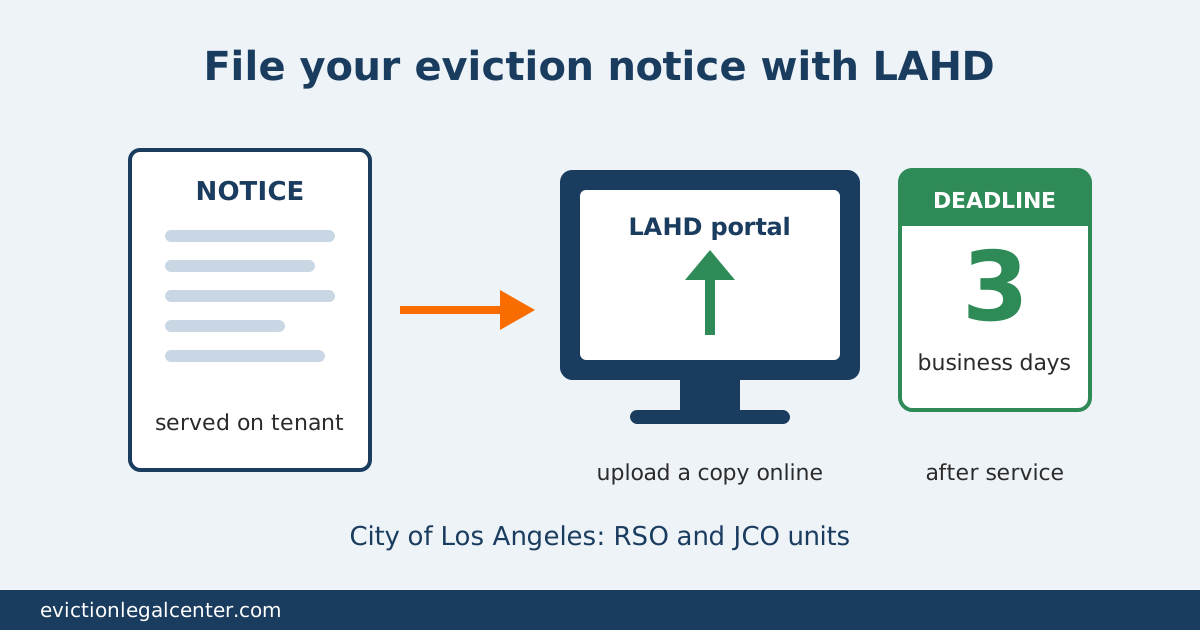
- In the City of Los Angeles, a copy of a notice terminating a tenancy in a unit covered by the Rent Stabilization Ordinance (RSO) or the Just Cause Ordinance (JCO) must be filed with the Los Angeles Housing Department (LAHD) within three business days of serving the tenant (LAMC 151.09 and 165.05 B.5).
- This includes at fault notices such as a 3 day notice to pay rent or quit, and no fault notices.
- Filing is done online through the LAHD eviction filing portal with a free Angeleno account. Mail is allowed only if you cannot file online.
- LAHD warns that a tenant may raise a missed filing as an affirmative defense in the unlawful detainer.
Who has to file
The rule applies to residential rental units inside the City of Los Angeles that are covered by either the RSO or the JCO. Together those two ordinances reach most rentals in the city. If you are not sure which rule covers your building, see our guide to RSO vs. JCO in Los Angeles.
Properties in other cities, such as Santa Monica, Pasadena or Glendale, are not part of this LAHD requirement. Unincorporated areas of Los Angeles County have their own filing rule with the County Department of Consumer and Business Affairs (DCBA). Always confirm the jurisdiction first.
Which notices must be filed
The ordinances require that a copy of any written notice terminating a tenancy be filed with LAHD within three business days of service. In practice that covers:
- At fault notices: 3 day notice to pay rent or quit, 3 day notice to perform covenants or quit, 3 day notice to quit for nuisance, damage or illegal use, and notices for refusing access or refusing to renew a lease on similar terms.
- No fault notices: owner or family move in, resident manager, Ellis Act withdrawal, compliance with a government order, and similar reasons. For these, LAHD first requires a Landlord Declaration of Intent to Evict with application fees, and relocation assistance must be paid. The no fault notice is then uploaded as well.
The three business day clock runs from the date of service on the tenant, not from the date you signed the notice. Weekends and City holidays do not count as business days, but do not wait until the last day. Filing the same day you serve is the safest habit.
How to file online
LAHD's preferred method is its online eviction filing system. According to LAHD's instructions, the steps are:
- Sign in with an Angeleno account (free to create) and choose "Submit New Notice."
- Select whether the notice is at fault or no fault.
- Find the property address and select the unit. Entering the assessor's parcel number (APN) helps locate the property. Enter the number of bedrooms.
- Enter each tenant's first and last name.
- Choose the notice type and enter the date the notice was served.
- Select the eviction reason and enter the rent information.
- Upload a copy of the notice exactly as it was served.
- Confirm who is filing, check the declaration box and submit.
You receive an email confirmation. Save it in the tenant file. LAHD also offers a public lookup to check whether a notice was filed.
If you cannot upload online, LAHD allows filing by mail using its Eviction Notice Filing Cover Sheet together with a copy of the notice. We file every notice online.
What filing does and does not do
LAHD states plainly that filing a notice does not mean LAHD reviewed or approved it. A notice with the wrong amount, a missing payment address, or a defective service method is still defective after it is filed. Filing is a separate requirement on top of the state rules for the notice itself, such as those discussed in Eshagian v. Cepeda.
For nonpayment cases, filing also does not override the City's eviction threshold. A tenant who owes one month of fair market rent or less for the unit size cannot be evicted for nonpayment, even with a properly filed notice.
What happens if you do not file
LAHD's guidance says that a tenant may raise the landlord's failure to file the notice as an affirmative defense in the unlawful detainer. In a case where the tenant contests the eviction, that defense can mean the case is lost and you must start over with a new notice, losing weeks or months of rent. A late filing is not much better, since the ordinance sets a specific deadline.
The Judicial Council complaint form for an unlawful detainer also asks whether the property is subject to a local rent or eviction control ordinance and whether you complied with it. Before we file a Los Angeles case we check that the LAHD confirmation exists and that its service date matches the proof of service.
How it fits with the unlawful detainer
- Day 0: serve the notice and complete the proof of service.
- Within 3 business days: upload the notice to LAHD and save the confirmation.
- After the notice expires: if the tenant has not paid, cured or moved, file the unlawful detainer in the Los Angeles Superior Court. Keep the notice, proof of service and LAHD confirmation together for trial.
- No fault cases: the Declaration of Intent to Evict and relocation payment come first. See Los Angeles relocation assistance amounts.
Common mistakes
- Forgetting that a 3 day notice to pay rent or quit has to be filed, not only no fault notices.
- Counting three calendar days instead of three business days, or counting from the date the notice was signed.
- Uploading a different version of the notice than the one served.
- Entering the wrong service date, so the filing appears late or does not match the proof of service.
- Assuming LAHD's acceptance means the notice is legally correct.
- Serving a new notice after a payment dispute and not filing the new one.
Let us handle the notice and the filing
Our online eviction notices are $150 each and are prepared for the City of Los Angeles rules, including the threshold check. If the tenant does not comply, full attorney representation for an uncontested residential eviction is an $850 flat fee, plus court, process server and sheriff fees paid to those agencies. Request a free case review to get started. For the full set of City rules, see our Los Angeles landlord compliance guide.
This article is general information about Los Angeles and California law, not legal advice for your situation. LAHD procedures and City ordinances change, so confirm the current requirements before serving a notice.
Related: Tenant stopped paying rent? | Request a case review
This article is general information about California law as of its date, not legal advice for your situation. Laws and local ordinances change, and court decisions can be reviewed or reversed. Reading it does not create an attorney client relationship.