Blog / Landlord guides
Evicting a Section 8 Tenant in California
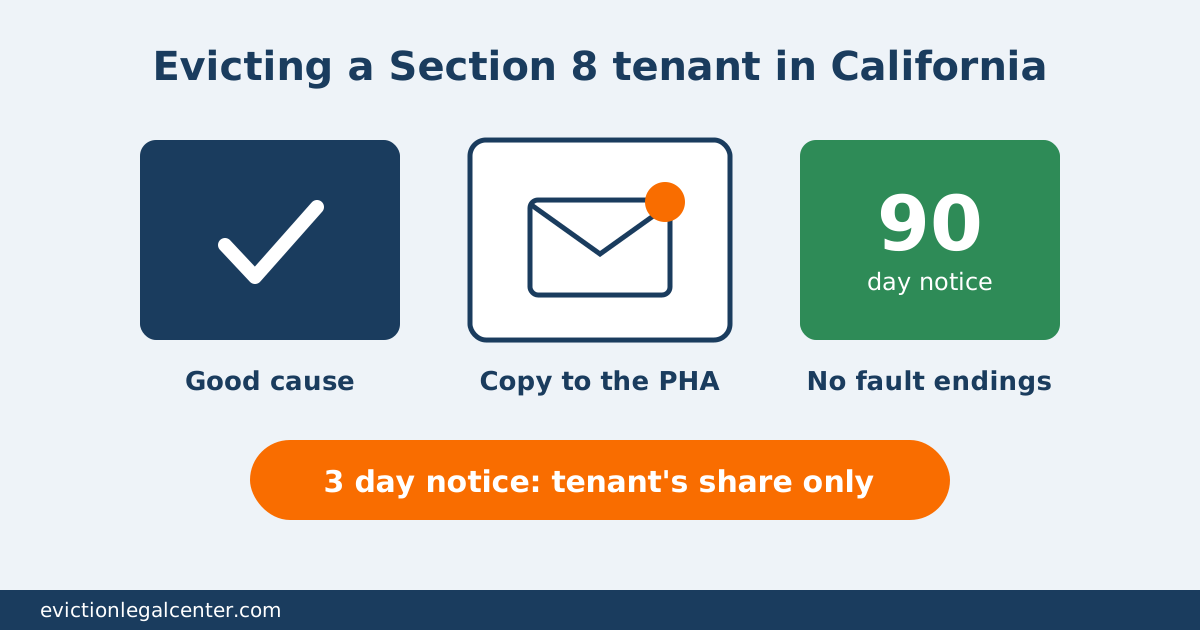
- A Section 8 tenancy is governed by three things at once: your lease, the HUD tenancy addendum and HAP contract, and California law.
- Federal rules require good cause to end the tenancy, and you must give the housing authority a copy of every eviction notice.
- A 3 day notice to pay rent or quit may demand only the tenant's share of the rent, never the housing authority's portion.
- Ending a subsidized tenancy without fault generally requires a 90 day notice under Civil Code section 1954.535, plus any local just cause requirements.
Evicting a tenant with a Housing Choice Voucher (Section 8) involves extra rules that do not apply to other tenants, and missing one of them is a common reason these cases are dismissed. Here is what landlords in Los Angeles County and Orange County need to know.
The HAP contract and the lease
When a voucher tenant moves in, you sign a Housing Assistance Payments (HAP) contract with the public housing agency, and your lease must include HUD's tenancy addendum. The addendum controls if it conflicts with your lease. The tenant pays the tenant's share of the rent, and the housing authority pays the rest directly to you.
The main housing authorities in our area are:
- Los Angeles County Development Authority (LACDA), for unincorporated Los Angeles County and many cities in the county.
- Housing Authority of the City of Los Angeles (HACLA), for the City of Los Angeles. Some other cities, such as Long Beach and Pasadena, run their own programs.
- Orange County Housing Authority (OCHA), for all Orange County cities and unincorporated areas except Anaheim, Garden Grove and Santa Ana, which have their own housing authorities.
Your HAP contract shows which agency must receive copies of your notices.
Good cause is required
Under HUD's regulation, 24 CFR 982.310, during the lease term the owner may terminate the tenancy only for:
- a serious or repeated violation of the lease, such as not paying the tenant's share of rent or damaging the unit;
- a violation of federal, state or local law that imposes obligations on the tenant in connection with the unit; or
- other good cause.
"Other good cause" can include the tenant refusing to sign a new lease, a history of disturbing neighbors or damaging property, the owner's desire to use the unit for personal or family use, or a business or economic reason such as selling or renovating the property. During the initial lease term, however, other good cause cannot be based on personal use or business reasons; it must be something the family did or failed to do. The lease must also allow termination for drug related criminal activity and certain violent criminal activity.
The federal Violence Against Women Act also protects voucher tenants. Being a victim of domestic violence, dating violence, sexual assault or stalking is not good cause to evict.
Nonpayment: only the tenant's share
The family is not responsible for the part of the rent the housing authority pays. If the housing authority is late or stops paying, including after a failed inspection, that is not a lease violation, and you cannot evict the tenant for it. Your 3 day notice to pay rent or quit must list only the tenant's unpaid portion. Including the subsidy amount makes the notice overstate the rent due, which can defeat the case. For the general rules, see our guide on what a 3 day notice must include.
Send copies to the housing authority
HUD's rule requires the owner to give the housing authority a copy of any owner eviction notice it gives the tenant. "Eviction notice" includes a notice to vacate and the complaint that starts the unlawful detainer. The notice to the tenant must also state the grounds for termination. Keep proof of when and how you sent the copies. LACDA's owner guidance also tells owners to provide a copy of a 90 day notice to LACDA.
The 90 day notice for ending a subsidized tenancy
Civil Code section 1954.535 applies when an owner terminates or does not renew a contract with a government agency that limits the tenant's rent, as with a HAP contract. The tenant must receive at least 90 days' written notice of the effective date, and during those 90 days the tenant cannot be required to pay more than the tenant's share. LACDA cites this section for owners who want to end a tenancy for business reasons or to move in when the tenant has not violated the lease. A 30 or 60 day notice is not enough.
Source of income protections
Since SB 329 took effect in 2020, California's Fair Employment and Housing Act treats Section 8 vouchers and other housing subsidies as a protected "source of income" (Government Code sections 12927 and 12955). You cannot refuse to rent to an applicant, or treat a tenant differently, because they use a voucher. An eviction or nonrenewal that looks motivated by the voucher can be challenged as discrimination, so document legitimate reasons carefully.
Local just cause rules still apply
The federal rules do not replace state and local law; you must satisfy all of them. The statewide Tenant Protection Act, the City of Los Angeles Just Cause Ordinance and Rent Stabilization Ordinance, the unincorporated Los Angeles County rules and Santa Ana's ordinance may each limit the reasons you can use, require specific notice language, require relocation assistance for no fault terminations, or require filing the notice with the city or county. Nonpayment cases may also be subject to local minimum rent thresholds, such as the unincorporated Los Angeles County rule. Get advice on how a threshold applies when only the tenant's share is unpaid.
Common mistakes
- Demanding the full contract rent, including the housing authority's portion, in a 3 day notice.
- Forgetting to send the housing authority a copy of the notice and the complaint.
- Serving a 30 or 60 day no fault notice instead of 90 days.
- Trying to end the tenancy for business reasons during the initial lease term.
- Ignoring local just cause and relocation rules because "Section 8 has its own rules."
We handle Section 8 evictions for landlords throughout Orange, Los Angeles, Riverside and San Bernardino Counties. Start with our online notices or request a case review before you serve anything.
This article is general information about California and federal law as of its date, not legal advice for your situation. Housing authorities can have their own procedures, so check your HAP contract and the agency's owner materials.
Related: What to do when a tenant stops paying rent | How much an eviction costs
This article is general information about California law as of its date, not legal advice for your situation. Laws and local ordinances change, and court decisions can be reviewed or reversed. Reading it does not create an attorney client relationship.