Blog / Landlord guides
How Much Does an Eviction Cost in California? (2026)
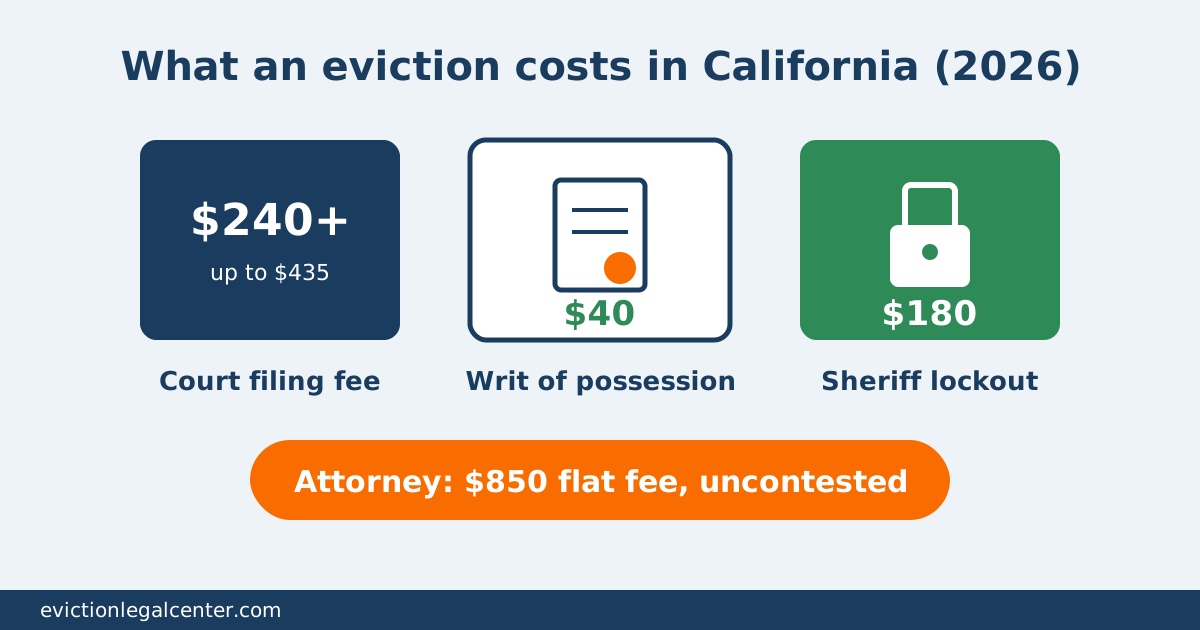
- The court filing fee for an unlawful detainer in 2026 is $240 if you demand $10,000 or less, $385 for more than $10,000 up to $35,000, and $435 above $35,000.
- After judgment, the court charges $40 to issue the writ of possession, and the sheriff charges $180 to post the notice to vacate and do the lockout.
- Our online notices are $150 and our filing packet for self-represented landlords is $850. Attorney representation is quoted after a free case review.
- For most landlords the biggest cost is not fees. It is the rent you lose while the case is pending.
Landlords often ask what an eviction will cost before they decide whether to serve a notice. The answer has two parts: the fixed fees charged by the court, the process server and the sheriff, and the variable costs, which are mostly attorney time and lost rent. Here is what to budget for a residential eviction in Orange County or Los Angeles County in 2026.
1. The notice
Every eviction starts with a written notice, such as a 3 day notice to pay rent or quit or a 30, 60 or 90 day notice. A mistake in the notice is the most expensive error in the whole case, because the court will dismiss the case and you pay the filing and service fees a second time. We prepare online eviction notices for $150 each, and you can read more about which notice you need.
2. Court filing fees
The filing fee for the unlawful detainer complaint is set by the Statewide Civil Fee Schedule that the Judicial Council publishes for all California superior courts. The amount depends on how much money you ask for in the complaint, meaning back rent plus damages. As of January 1, 2026:
- $240 for a limited civil unlawful detainer demanding $10,000 or less.
- $385 for a limited civil unlawful detainer demanding more than $10,000 and up to $35,000.
- $435 for an unlimited civil unlawful detainer demanding more than $35,000.
The two limited civil amounts include a $15 surcharge that only unlawful detainer plaintiffs pay. If the tenant files an answer, the tenant pays a separate first appearance fee. Most residential nonpayment cases fall in the $240 or $385 tier.
3. Serving the tenant
The summons and complaint must be served on each tenant, usually together with a prejudgment claim of right to possession so that unknown occupants are covered by the judgment. Most landlords use a registered process server. Prices vary by company, by the number of people to be served, and by how hard the tenant is to find. Ask for a quote that includes extra attempts and posting if personal service fails.
4. Writ of possession and sheriff lockout
Once you have a judgment for possession, the court issues a writ of possession for a $40 fee. The writ then goes to the sheriff. Government Code section 26733.5 sets the sheriff's fee at $105 to serve the notice to vacate and $75 more to remove the occupants and put you in possession, for a total of $180. The Orange County Sheriff's Civil Division lists the same $180 fee for a writ of possession of real property, plus $100 if the notice has to be reposted. The Los Angeles County Sheriff's Civil Management office charges the statutory fee as well. Confirm the current amount when you submit the writ. For the full process, see our guide to the writ of possession and sheriff lockout.
5. Attorney fees
You have two choices with our office (see our eviction fees page):
- Self-represented filing packet, $850. We prepare the complaint, summons, civil case cover sheet and the mandatory UD-101 cover sheet, plus the LASC CIV 109 addendum for Los Angeles cases. You file and handle the case yourself.
- Attorney representation. We file, track service, request the default and judgment or handle the trial, and send the writ to the sheriff. The fee is quoted after a free case review.
If your lease has an attorney fee clause and you win, the court may award reasonable attorney fees against the tenant. Without such a clause, each side usually pays its own lawyer. The prevailing party can also recover court costs, which include the filing and service fees above.
6. Lost rent while the case is pending
An uncontested case commonly takes about 5 to 8 weeks from notice to lockout, and a contested case can take 2 to 4 months. See how long an eviction takes. At $2,500 a month, two months of unpaid rent is $5,000, more than all the fees combined. The judgment can include unpaid rent and holdover damages, but collecting from a former tenant is not guaranteed. That is why speed and an accurate notice matter so much, and why a cash for keys agreement is sometimes the cheaper option.
7. Contested cases
If the tenant files an answer, the case goes to trial. Costs rise because of discovery, settlement conferences, motions and trial time, and a jury trial adds its own fees. Habitability defenses, retaliation claims and local just cause ordinances in the City of Los Angeles, unincorporated Los Angeles County and Santa Ana make cases more complex. We quote contested cases after a case review, once we know the defenses.
Cost comparison
| Item | Self-represented with our filing packet | Uncontested with an attorney | Contested |
|---|---|---|---|
| Notice | $150 online notice (optional) | $150 online notice | $150 online notice |
| Our fee | $850 packet | Quoted after case review | Quoted after case review |
| Court filing fee | $240, $385 or $435 | $240, $385 or $435 | $240, $385 or $435, plus any jury fees |
| Process server | Varies | Varies | Varies |
| Writ of possession | $40 | $40 | $40 |
| Sheriff lockout | $180 | $180 | $180 |
| Who does the work | You file, serve and request judgment | Our office | Our office, through trial |
Court and sheriff amounts are the 2026 statewide fees, and they are paid directly to those agencies.
Common mistakes that raise the cost
- Including late fees or utilities in a 3 day notice, which can get the case dismissed so you pay all the fees again.
- Accepting partial rent after the notice without advice.
- Changing the locks or removing belongings yourself, which exposes you to damages.
- Waiting weeks to start the case while rent keeps going unpaid.
- Ignoring local rules, such as the rent thresholds in the unincorporated Los Angeles County and City of Los Angeles ordinances.
This article is general information about California law and fees as of its date, not legal advice for your situation. Court and sheriff fees can change, so confirm them when you file.
Related: What to do when a tenant stops paying rent | Request a case review
This article is general information about California law as of its date, not legal advice for your situation. Laws and local ordinances change, and court decisions can be reviewed or reversed. Reading it does not create an attorney client relationship.