Blog / Landlord guides
Writ of Possession and Sheriff Lockout in LA and OC
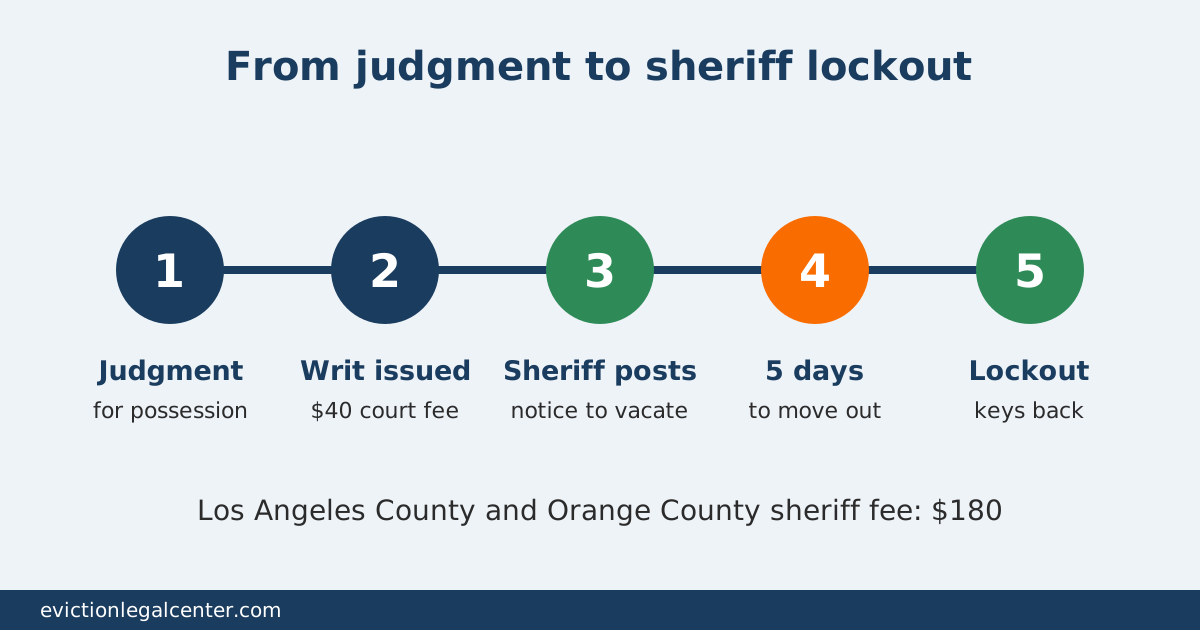
- Only the sheriff can remove a tenant. Winning the case is not enough; you need a writ of possession from the court.
- The court charges $40 to issue the writ. The sheriff's fee is $180 under Government Code section 26733.5.
- The sheriff serves or posts a notice giving the occupants 5 days to leave, then returns to put you in possession.
- Until the lockout, do not change the locks, cut utilities or remove the tenant's belongings.
The lockout is the last step of a California eviction, and it is where many landlords get impatient. The tenant has lost in court, yet they are still in the unit. Here is how the writ of possession and the sheriff lockout work in Los Angeles County and Orange County, what it costs, and what you can and cannot do while you wait.
Step 1: Judgment for possession
You get a judgment for possession in one of two ways. If the tenant does not respond to the complaint within the deadline (10 court days after personal service), the landlord requests entry of default and a default judgment. If the tenant answers, the judgment comes after trial or through a stipulated judgment in a settlement. A settlement may set a later move out date, and the writ cannot be enforced before that date.
Step 2: The court issues the writ
After judgment, the clerk issues a writ of possession of real property on Judicial Council form EJ-130. The fee is $40 under the Statewide Civil Fee Schedule. The writ tells the occupants that they must leave within 5 days after it is served, and that personal property left behind may be sold or disposed of unless the owner pays the reasonable cost of storage and claims it within 15 days after the landlord takes possession. Order enough copies for every occupant and for the sheriff.
Step 3: Deliver the writ to the sheriff
In Los Angeles County, writs go to the Los Angeles County Sheriff's Department Civil Management office, part of its Court Services Division. In Orange County, they go to the Orange County Sheriff's Department Civil Division. You submit the original writ, copies, the sheriff's written instructions with the property address and your contact information, and the fee.
Government Code section 26733.5 sets the sheriff's fee at $105 to serve the writ and notice to vacate and $75 to remove the occupants and put you in possession, for a total of $180. The Orange County Sheriff's fee schedule lists $180 for a writ of possession and $100 to repost a notice. Check the current fee with the sheriff's office before you submit, and keep your receipt; it is a recoverable cost.
Step 4: The 5 day notice to vacate
Under Code of Civil Procedure section 715.020, a deputy serves a copy of the writ on an occupant or, if no one is available, posts it in a conspicuous place on the property and serves the tenant by mail. The occupants then have 5 days to move out. The notice gives the lockout date. If the occupants are still there when the 5 days end, the sheriff removes them. The time between submitting the writ and the posting depends on the sheriff's workload.
Step 5: Lockout day
On the scheduled day, the deputy goes to the property, removes anyone still inside, and puts you in possession. Plan to be there, or have your property manager there, at the scheduled time, and have a locksmith ready to change the locks immediately. If no one meets the deputy, the lockout may be cancelled and you may have to pay again. The deputy does not move furniture. Belongings left behind become your responsibility to store; see our guide on tenant belongings left after an eviction.
An occupant who was not named in the case may try to stop the lockout by filing a claim of right to possession. If the prejudgment claim of right to possession was served with the summons and complaint, those claims are very limited. This is one reason careful service at the start of the case pays off at the end.
Typical timeline
- Writ issued: after judgment is entered, on the court's processing schedule.
- Sheriff posts the notice: when the sheriff's office schedules it, which depends on its workload.
- Lockout: after the 5 day period ends, on the date shown on the notice.
In our experience, plan on roughly 2 to 4 weeks from judgment to lockout. For the whole case, see how long an eviction takes in California.
What the landlord must do
- Give the sheriff an accurate address, unit number and a reliable contact phone for you or your agent.
- Be present, or send an agent, at the lockout and change the locks right away.
- Inventory, photograph and store any belongings left behind, and follow the notice rules before disposing of them.
- Handle the security deposit with an itemized statement within 21 days after you regain possession.
What the landlord must not do
- Do not change the locks, remove doors or windows, or shut off utilities to force the tenant out. Civil Code section 789.3 makes the landlord liable for actual damages plus $100 for each day of the violation, with a minimum of $250.
- Do not remove or throw away the tenant's belongings before the lockout.
- Do not accept rent after the judgment without legal advice. It can create confusion about whether a new tenancy began.
- Do not proceed if the tenant files for bankruptcy. The automatic stay generally stops the lockout until the bankruptcy court grants relief.
If you need help getting from judgment to lockout, our eviction process guide explains every step. If you want an attorney to handle it, request a free case review and we will quote a flat fee.
This article is general information about California law as of its date, not legal advice for your situation. Sheriff procedures and fees can change, so confirm them with the sheriff's office when you submit the writ.
Related: How much an eviction costs in California | Request a case review
This article is general information about California law as of its date, not legal advice for your situation. Laws and local ordinances change, and court decisions can be reviewed or reversed. Reading it does not create an attorney client relationship.