Blog / Landlord guides
Tenant Belongings Left After an Eviction in California
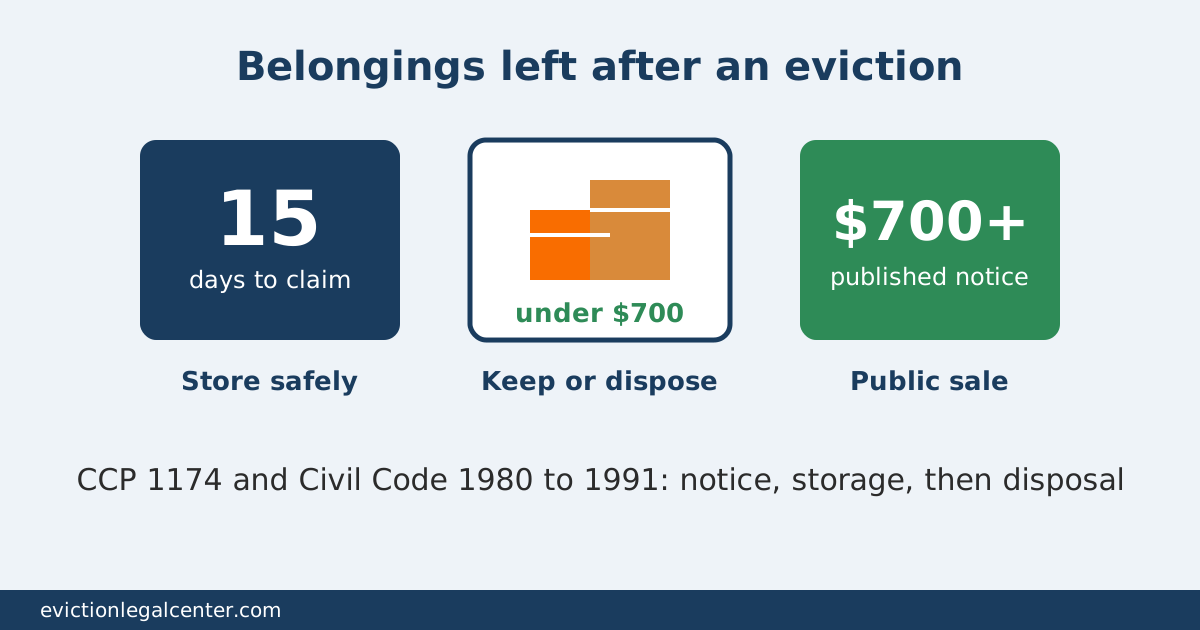
- After a sheriff lockout, the landlord must store the tenant's belongings in a safe place. The tenant has 15 days after you take possession to claim them by paying the reasonable cost of storage.
- Unclaimed property is handled under Civil Code sections 1980 to 1991. If you reasonably believe it is worth less than $700, you may keep it or dispose of it. If it is worth more, it must be sold at a public sale.
- When a tenant moves out without a lockout, you must give written notice and wait at least 15 days after personal delivery or 18 days after mailing.
- Never throw everything out on lockout day. Improper disposal can make you liable for the value of the property.
The sheriff puts you back in possession, and the unit is still full of furniture, clothes and boxes. California law tells landlords exactly what to do with those belongings, and following the steps protects you from a claim later.
After a sheriff lockout: CCP 1174
Code of Civil Procedure section 1174 governs personal property left on the premises after the writ of possession is executed. The writ itself warns the occupants that property remaining after the landlord takes possession may be sold or disposed of unless the tenant or owner pays the reasonable cost of storage and takes the property back within 15 days after the landlord takes possession (CCP 715.010).
The landlord's duties are:
- Store the property in a place of safekeeping until it is released or disposed of. You can leave it in the unit or move it to a storage location, but keep it safe and secure.
- Release it to the tenant, or to a person you reasonably believe is the owner, who claims it in time and pays the storage costs allowed by Civil Code section 1990.
- Dispose of unclaimed property only as Civil Code section 1988 allows, described below.
If you believe items belong to someone other than the tenant, such as a roommate or a furniture rental company, section 1174 also requires you to give that person notice under Civil Code section 1983.
When a tenant leaves without a lockout: Civil Code 1980 to 1991
If the tenancy has ended and the tenant moved out or abandoned the unit leaving belongings behind, the same chapter of the Civil Code applies. The landlord gives a written notice describing the property, where it can be claimed, and the cost of storage. Civil Code section 1984 provides a sample form. The claim deadline must be at least:
- 15 days after the notice is personally delivered, or
- 18 days after the notice is deposited in the mail.
Under Civil Code section 1983, a mailed notice goes by first class mail to the tenant's last known address, with a copy to the unit the tenant vacated. If you have reason to believe it will not be received there, also send it to any other address where the tenant can reasonably be expected to get it. Keep a copy and proof of mailing.
The $700 rule
Under Civil Code section 1988, what you do with unclaimed property depends on its resale value:
- Less than $700 total. If you reasonably believe the total resale value of the unclaimed property is less than $700, you may keep it for your own use or dispose of it in any manner.
- $700 or more. The property must be sold at a public sale by competitive bidding. Notice of the sale must be published in a newspaper of general circulation in the county, with the last publication at least five days before the sale. From the proceeds you may deduct the costs of storage, advertising and sale. Any remaining balance goes to the county treasury within 30 days, and the former owner can claim it from the county within one year.
"Resale value" means what the items would bring at a sale, not what the tenant paid for them. A used sofa, worn clothes and kitchen items are often worth far less than people assume. Photographs and a written inventory support your estimate if it is ever challenged.
Vehicles left behind
Cars, motorcycles and trailers are not handled like furniture. A landlord cannot simply sell a vehicle. Removal from private property is governed by Vehicle Code section 22658, which allows towing only in specified situations, such as when proper tow away signs are posted at each entrance, or when the vehicle is inoperable and the local police were notified at least 24 hours earlier. The property owner must notify the local police or traffic agency within one hour after authorizing a tow. If you are unsure, call the police non emergency line and a licensed tow company before acting. Mobilehomes are excluded from these rules and require their own procedures.
What not to do
- Do not remove or discard belongings before the sheriff lockout. That is a self help eviction.
- Do not throw everything in a dumpster on lockout day. The tenant has 15 days to reclaim the property.
- Do not hold belongings until the tenant pays back rent. Release depends on paying storage costs, not on the unpaid rent. Unpaid rent is collected through the judgment.
- Do not overstate storage charges. Charge only reasonable costs of storage. If you keep the items in the unit, the charge is the fair rental value of the space reasonably needed to store them.
- Do not sell valuable items privately when the total is $700 or more. Use a public sale with published notice.
- Do not ignore items owned by others, such as rented appliances or a roommate's property. Give them notice too.
A simple checklist
- On lockout day, change the locks, photograph every room and inventory what was left.
- Store the items safely and track your storage costs.
- Release items to anyone entitled to them who claims them in time.
- After the deadline, keep or dispose of property under $700, or arrange a public sale if it is worth more.
For the steps that come before this, see our guide to the writ of possession and sheriff lockout. Remember that the security deposit is a separate obligation with its own 21 day deadline.
This article is general information about California law as of its date, not legal advice for your situation. When the property is valuable or ownership is unclear, get advice before you dispose of anything.
Related: How much an eviction costs in California | Request a case review
This article is general information about California law as of its date, not legal advice for your situation. Laws and local ordinances change, and court decisions can be reviewed or reversed. Reading it does not create an attorney client relationship.