Blog / Landlord guides
California Security Deposit Rules for Landlords (2026)
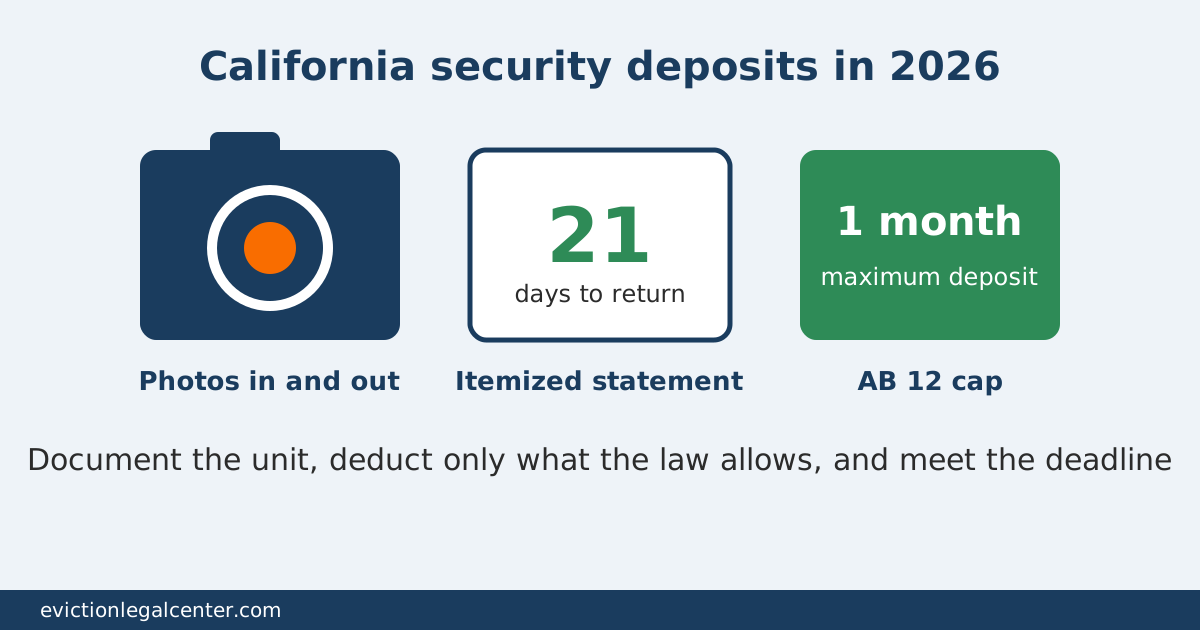
- Most landlords may collect no more than one month's rent as a security deposit (AB 12, since July 1, 2024).
- Photos are now required: at move out (since April 1, 2025) and at move in for tenancies that began on or after July 1, 2025 (AB 2801).
- You have 21 days after the tenant moves out to return the deposit or send an itemized statement with photos and receipts.
- Withholding in bad faith can cost up to twice the deposit in penalties, plus the deposit itself.
Security deposit disputes are among the most common claims California tenants bring against landlords, and the rules changed twice in the last two years. Here is what landlords in Orange County and Los Angeles County need to know about collecting, documenting and returning a security deposit under Civil Code section 1950.5 in 2026.
1. How much you can collect
Since July 1, 2024, AB 12 limits the security deposit for most residential tenancies to one month's rent, whether the unit is furnished or unfurnished. The limit includes anything labeled a "last month's rent," "cleaning fee" or similar charge that is really a deposit.
There is a narrow small landlord exception. A landlord who is a natural person, a family trust, or an LLC whose members are all natural persons, and who owns no more than two residential rental properties with a total of no more than four units, may collect up to two months' rent. The exception does not apply when the tenant is a service member. If you are unsure whether you qualify, collect one month.
2. Take photos at move in and move out
AB 2801 added a photo requirement to Civil Code 1950.5:
- Move in (tenancies starting on or after July 1, 2025): photograph the unit immediately before or at the start of the tenancy.
- Move out (since April 1, 2025): photograph the unit within a reasonable time after you get possession back, and before you make any repairs or cleaning you plan to deduct.
- After repairs: photograph the completed work you are charging for.
The photos go to the tenant with the itemized statement. Without them, your deductions are much harder to defend in small claims court. Date stamped photos, organized by room, are the best practice. Our free property management software lets you keep inspection photos and documents with each lease.
3. What you may deduct
- Unpaid rent.
- Repair of damage beyond ordinary wear and tear caused by the tenant or their guests.
- Cleaning needed to return the unit to the level of cleanliness it had at move in.
- Replacing or restoring furniture and other personal property, if the lease allows it, beyond ordinary wear and tear.
You may not deduct for normal aging of paint, carpet and fixtures, or for conditions that existed before the tenant moved in. That is why move in photos matter: they are your proof of the starting condition.
4. The 21 day deadline and the itemized statement
Within 21 days after the tenant vacates, you must either return the full deposit or send an itemized statement of deductions and refund the balance. For any repair or cleaning charge of $125 or more, include copies of receipts or invoices. If the work cannot be finished within 21 days, you may give a good faith estimate and send the receipts within 14 days after the work is done. Deductions for your own labor must state the time spent and a reasonable hourly rate.
Since 2026, AB 414 also makes it easier to refund deposits electronically and to send the itemization by email when the landlord and tenant agree. Put the tenant's choice in writing at move out.
5. The tenant's right to a pre move out inspection
When a tenancy is ending, you must give the tenant written notice of the right to request an initial inspection before move out. At that inspection you give the tenant a written list of proposed deductions so they can fix the problems themselves. Skipping this step weakens your deductions later.
6. Penalties for getting it wrong
If a court finds that a landlord kept any part of a deposit in bad faith, the tenant can recover the amount wrongfully withheld plus a penalty of up to twice the deposit. Missing the 21 day deadline can also cost you the right to keep any deduction at all.
Common mistakes
- Charging more than one month's rent without qualifying for the small landlord exception.
- No move in photos, so there is no proof the damage is new.
- Deducting for normal wear and tear, such as faded paint or worn carpet.
- Missing receipts for charges of $125 or more.
- Sending the statement on day 22.
- Using the deposit as a reason to delay an eviction. Unpaid rent and the deposit are handled separately; see our guide on what to do when a tenant stops paying rent.
This article is general information about California law, not legal advice for your situation. Rules can change, and some cities add their own requirements.
Related: Rent ledger records that hold up in court | Request a case review
This article is general information about California law as of its date, not legal advice for your situation. Laws and local ordinances change, and court decisions can be reviewed or reversed. Reading it does not create an attorney client relationship.